
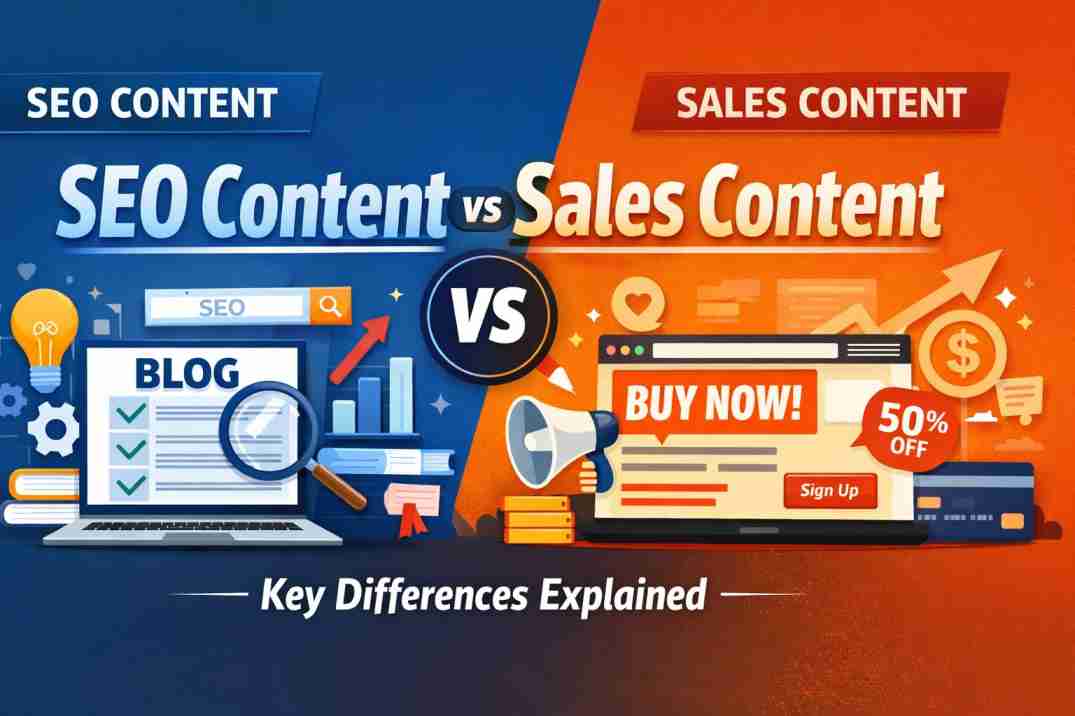
In digital marketing, content is not just about writing words — it’s about achieving goals. However, many businesses confuse SEO content with sales content, expecting blog posts to sell instantly or landing pages to rank overnight.
If you’re a startup, agency, or small business owner planning your content strategy, understanding the difference between SEO Content vs Sales Content is critical for growth.
Let’s break it down clearly.
An SEO article targeting that keyword will aim to rank on Google and bring traffic over time.
Key Characteristics of SEO Content:
- Keyword-focused
- Optimized headings (H1, H2, H3)
- Internal & external links
- Long-form (often 1000+ words)
- Informational intent
- Evergreen value
SEO content works best for:
- Top-of-funnel audiences
- Brand awareness
- Authority building
- Organic lead generation
What is Sales Content?
Sales content is content designed to persuade readers to take immediate action — buy, sign up, book a call, or download.
It focuses on:
- Conversions
- Emotional triggers
- Urgency
- Benefits over information
Examples of Sales Content:
- Landing pages
- Product descriptions
- Email marketing sequences
- Sales pages
- Ad copy
- Service pages
Example:
A landing page saying:
That’s sales content – direct, persuasive, conversion-focused.
Key Characteristics of Sales Content:
- Strong headlines
- Clear value proposition
- Emotional appeal
- Testimonials & proof
- Call-to-action (CTA)
- Short, punchy paragraphs
Sales content works best for:
- Bottom-of-funnel audience
- Paid traffic campaigns
- Lead conversion
- Direct revenue growth
SEO Content vs Sales Content: Core Differences
Here’s a simplified comparison:
| Factor | SEO Content | Sales Content |
|---|---|---|
| Primary Goal | Traffic | Conversion |
| Target Audience | Information seekers | Ready-to-buy users |
| Tone | Educational | Persuasive |
| Length | Long-form | Short to medium |
| CTA | Soft (Learn more) | Strong (Buy now) |
| Time to Results | Slow & long-term | Immediate |
1. Purpose Difference
- SEO content builds visibility.
- Sales content drives action.
If SEO is farming, sales content is harvesting.
- SEO content attracts potential customers.
- Sales content converts them.
2. Audience Intent Difference
In digital marketing, intent matters.
There are mainly three types of search intent:
- Informational
- Navigational
- Transactional
SEO content targets informational intent.
Sales content targets transactional intent.
For example:
- “What is SEO?” → SEO content
- “Hire SEO agency near me” → Sales content
3. Writing Style Difference
SEO Content Style:
- Detailed explanations
- Structured headings
- Keyword variations
- Data-backed
- Neutral tone
Sales Content Style:
- Emotional storytelling
- Benefit-driven
- Pain-point focused
- Clear CTA
- Urgency phrases
ALSO READ- Best Digital Marketing Strategy for Startups
4. Structure Difference
SEO content structure:
- Introduction
- Problem explanation
- Detailed sections
- FAQs
- Conclusion
Sales content structure:
- Hook
- Problem agitation
- Solution
- Proof
- Offer
- CTA
Sales pages often follow AIDA:
- Attention
- Interest
- Desire
- Action
5. Timeline Difference
SEO content:
- Takes 3–6 months to show results
- Compounds over time
- Brings recurring traffic
Sales content:
- Works immediately with paid ads
- Depends on the traffic source
- Requires optimization for conversion rate
6. Metrics That Matter
SEO Content Metrics:
- Organic traffic
- Keyword rankings
- Time on page
- Backlinks
- Impressions
Sales Content Metrics:
- Conversion rate
- Click-through rate (CTR)
- Cost per lead (CPL)
- Revenue generated
- Return on ad spend (ROAS)
Different goals = different success measurements.
Can SEO Content and Sales Content Work Together?
Absolutely – and they should.
The smartest digital marketing strategies combine both.
Here’s how the funnel works:
- SEO Blog Article ranks on Google.
- Reader consumes valuable content.
- Internal link directs them to the service page.
- Sales page converts them.
That’s how sustainable businesses grow.
Example of Combined Strategy
Let’s say you run a digital marketing agency.
Step 1: Publish an SEO article
“Best Digital Marketing Strategy for Startups”
Step 2: Inside the article, add CTA
“Need expert help? Explore our Digital Marketing Services.”
Step 3: User lands on a persuasive sales page.
Traffic + Conversion = Growth.
Common Mistakes Businesses Make
1. Expecting SEO blogs to sell immediately
SEO builds trust first.
2. Writing sales pages stuffed with keywords
Google doesn’t rank overly promotional pages easily.
3. Ignoring search intent
Wrong content for wrong audience = low results.
4. No internal linking
SEO content without direction wastes traffic.
When Should You Use SEO Content?
Use SEO content when:
- You want long-term organic traffic
- You are building brand authority
- You have limited ad budget
- You want consistent inbound leads
- You want to dominate niche keywords
When Should You Use Sales Content?
Use sales content when:
- You are running paid ads
- You have warm traffic
- You want immediate conversions
- You are launching a new product/service
- You need higher conversion rates
Final Verdict: SEO Content vs Sales Content
Both are powerful – but they serve different purposes.
- If SEO content is the magnet, sales content is the closer.
- If SEO content educates, sales content persuades.
- If SEO content builds trust, sales content builds revenue.
The best strategy is not choosing one over the other — but integrating both into a structured marketing funnel.
Conclusion
Understanding the difference between SEO content and sales content helps businesses:
- Avoid unrealistic expectations
- Build smarter content strategies
- Improve traffic quality
- Increase conversions
- Scale sustainably
In 2026 and beyond, successful brands will not just create content — they will create purpose-driven content aligned with intent and funnel stages.
For more information, hire a team of SEO STARTUP to grow your business online.
ALSO READ
SEO vs Google Ads: Which Is Better for Your Business
How Google Ads Helps Grow a Business Online
How to Analyze Keyword Difficulty and Competition