
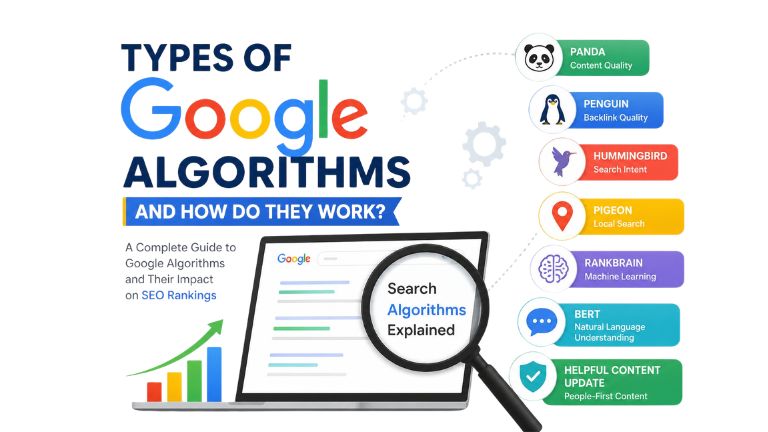
Google processes billions of searches every day, and behind every search result is a complex system of ranking signals known as Google algorithms. These algorithms determine which websites appear on the first page, which pages rank lower, and how users find the most relevant content.
Understanding the types of Google algorithms and how they work is essential for website owners, bloggers, SEO professionals, and digital marketers who want to improve online visibility and stay competitive.
In this guide, you’ll learn about the major Google algorithms, their functions, and how they impact search rankings.
What Are Google Algorithms?
Google algorithms are a set of rules, calculations, and ranking systems used by Google Search to deliver the most relevant, useful, and high-quality results for user queries.
Google uses hundreds of ranking factors, including:
- Content quality
- Backlinks
- Keyword relevance
- Website speed
- Mobile-friendliness
- User experience
- Security
These algorithms are continuously updated to improve search quality and prevent spammy practices.
How Does the Google Algorithm Work?
Google’s algorithm works in three major stages:
1. Crawling
Google bots (also called spiders) scan websites across the internet to discover pages.
2. Indexing
Once pages are crawled, Google stores and organizes them in its search index.
3. Ranking
When a user searches for something, Google’s algorithms analyze indexed pages and rank them based on relevance, authority, and quality.
In simple words:
Search Query → Google Crawls → Indexes → Ranks Best Results
Major Types of Google Algorithms
1. Google Panda Algorithm
Launch Year:
2011
Purpose:
Panda focuses on content quality and penalizes websites with:
- Thin content
- Duplicate content
- Keyword stuffing
- Low-quality articles
How It Works:
Panda evaluates whether content is valuable, original, and informative.
Best Practice:
Create high-quality, user-focused, and unique content.
2. Google Penguin Algorithm
Launch Year:
2012
Purpose:
Penguin targets unnatural backlink practices.
Penalizes:
- Spammy backlinks
- Link farms
- Paid links
- Over-optimized anchor text
How It Works:
Google checks link quality instead of just quantity.
Best Practice:
Build natural, relevant, and authoritative backlinks.
3. Google Hummingbird Algorithm
Launch Year:
2013
Purpose:
Hummingbird improved Google’s understanding of search intent.
Focus:
- Conversational queries
- Semantic search
- Context over exact keywords
Example:
Instead of matching “best pizza Delhi,” Google understands the intent behind “Where can I get the best pizza near me?”
Best Practice:
Optimize content for user intent, not just keywords.
4. Google Pigeon Algorithm
Launch Year:
2014
Purpose:
Pigeon improves local search results.
Focus:
- Location relevance
- Google Maps
- Local business listings
Example:
“CA near me” or “best SEO company in Gurgaon”
Best Practice:
Optimize Google Business Profile and local SEO.
5. Google Mobilegeddon Algorithm
Launch Year:
2015
Purpose:
Boost mobile-friendly websites in mobile search.
Penalizes:
- Non-responsive websites
- Poor mobile usability
Best Practice:
Use responsive web design and mobile optimization.
6. RankBrain Algorithm
Launch Year:
2015
Purpose:
RankBrain uses machine learning to interpret search queries.
Focus:
- User behavior
- Click-through rate (CTR)
- Search intent
- Relevance
How It Works:
RankBrain learns from how users interact with results.
Best Practice:
Create engaging titles, relevant content, and better user experience.
7. Google Medic Update
Launch Year:
2018
Purpose:
Focused on YMYL (Your Money Your Life) websites such as:
- Health
- Finance
- Legal
Focus:
E-E-A-T principles:
- Experience
- Expertise
- Authoritativeness
- Trustworthiness
Best Practice:
Show credentials, trustworthy information, and accurate content.
8. BERT Algorithm
Launch Year:
2019
Purpose:
BERT helps Google understand natural language processing.
Focus:
- Sentence context
- User intent
- Prepositions and phrasing
Example:
Google better understands “can you get medicine for someone pharmacy.”
Best Practice:
Write naturally for humans, not robots.
9. Helpful Content Update
Launch Year:
2022
Purpose:
Reward people-first content and demote search-engine-first content.
Penalizes:
- AI spam
- Clickbait
- Unhelpful pages
Best Practice:
Create useful, expert-driven, and audience-focused content.
Core Algorithm Updates
Google also releases broad core updates several times a year.
Purpose:
Improve overall search relevance.
Impact:
Websites may gain or lose rankings depending on:
- Content quality
- User experience
- Authority
- Competitor improvements
Best Practice:
Regularly audit and improve website quality.
Key Ranking Factors Google Algorithms Consider
Content Factors:
- Relevance
- Keyword placement
- Originality
- Freshness
Technical SEO:
- Site speed
- HTTPS security
- Mobile-friendliness
- Crawlability
Authority:
- Quality backlinks
- Domain trust
- Brand reputation
User Experience:
- Bounce rate
- CTR
- Page experience
Why Google Algorithms Matter for SEO
Understanding Google algorithms helps businesses:
Increase Organic Traffic
By aligning with ranking factors.
Avoid Penalties
By staying away from black-hat SEO.
Improve User Trust
By offering quality experiences.
Stay Competitive
By adapting to search changes.
How to Stay Safe from Google Algorithm Penalties
1. Publish High-Quality Content
Focus on solving user problems.
2. Avoid Spammy SEO
No keyword stuffing or paid links.
3. Improve Technical SEO
Optimize speed, structure, and mobile usability.
4. Follow E-E-A-T
Build authority and trust.
5. Monitor Updates
Keep track of Google’s core changes.
Future of Google Algorithms
Google is increasingly powered by:
- AI and machine learning
- Search intent analysis
- Voice search optimization
- Personalized search
- User experience signals
This means SEO is shifting from “ranking tricks” to genuine value creation.
Conclusion
Google algorithms are designed to provide users with the best possible search results. From Panda and Penguin to BERT and Helpful Content Updates, each algorithm serves a specific purpose in improving search quality.
To succeed in SEO, focus on:
- Helpful content
- User intent
- Technical optimization
- Quality backlinks
- Trustworthiness
The better your website serves users, the better Google’s algorithms are likely to reward it.
LinkedIn Marketing Tips for B2B Businesses
How to Fix Google Business Profile Suspension
How to Optimize Blog Posts for Featured Snippets in 2026